Introduction
위치 | 서울특별시 관악구 남부순환로 2076
용도 | 거주시설, 상업시설
대지면적 | 3495 ㎡
건축면적 | 2413 ㎡
층수 | 지하 1층 – 3층
Location | 2076 Nambu Ro, Gwanak-gu, Seoul
Program | Residential, Commercial
Site Area | 3495 ㎡
Building Area | 2413 ㎡
Floors | B1 – 3F
Agenda
사당역 근처 남현동에는 과거의 역사를 보존하기 위한 아름다운 적벽돌의 건축물이 위치하고 있다. 그 곁을 지나는 현대적인 건물들과 대비되며, 쏜살같이 흘러가는 도시의 시간 속에서 잠시 과거를 붙잡아두려는 듯 묵묵히 그 자리를 지키고 있는 것이다. 그 노력이 더 빛날 수 있도록 새로운 흐름을 만든다는 것은 단순한 보존을 넘어선 새로운 가치를 만들어가는 과정이 될 것이다.
Near Sadang Station in Namhyeon-dong stands a beautiful red-brick building, preserving traces of the past. In contrast to the modern structures that surround it, it quietly holds its ground, as if determined to capture a fragment of history amid the swift passage of urban time. Creating a new current that allows this effort to shine even brighter is not merely about preservation—it is a process of building new value beyond what already exists.
Prologue

남서울 미술관은 대한제국 시절 벨기에 영사관으로 사용된 건물을 보존하기 위해 지금의 남현동 예술인 마을 초입으로 옮겨진 건물이다. 하지만 유동 인구는 많으나 머무는 시간이 짧은 사당의 위치적 특성과 함께 주변과의 관계성, 그리고 건물이 미술관의 용도로 설계되지 않았다는 점에서 많은 아쉬움이 남는다.
특히 현재의 미술관은 그저 지나가는 공간으로써만 인식되고 있는데, 이는 건축물과 사당역의 중간에 위치한 거대한 볼륨의 은행 시각적으로 미술관을 동선에서 제외하고 있기 때문이다. 이러한 이유로 예술인의 마을을 사람들이 인식하는 데에 어려움이 있고 이를 해결하기 위해서 남서울 미술관을 드러냄으로써 새로운 흐름을 만들 필요가 있다.
The Nam-Seoul Museum of Art is a relocated building that once served as the Belgian Consulate during the Korean Empire, moved to the entrance of today’s Namhyeon-dong Artist Village to preserve its historic architecture. However, despite the area’s high foot traffic, Sadang’s transient nature—where people rarely linger—along with the museum’s limited connection to its surroundings and the fact that it was never originally designed as an art museum, leaves much to be desired.
Currently, the museum is perceived as little more than a pass-through space. This is largely due to the imposing volume of a bank situated between the museum and Sadang Station, which visually removes the museum from the pedestrian flow. As a result, people often fail to recognize the presence of the Artist Village. To address this, the Nam-Seoul Museum of Art must be brought visually and spatially to the forefront, creating a new flow that redefines its role in the area.
Concept

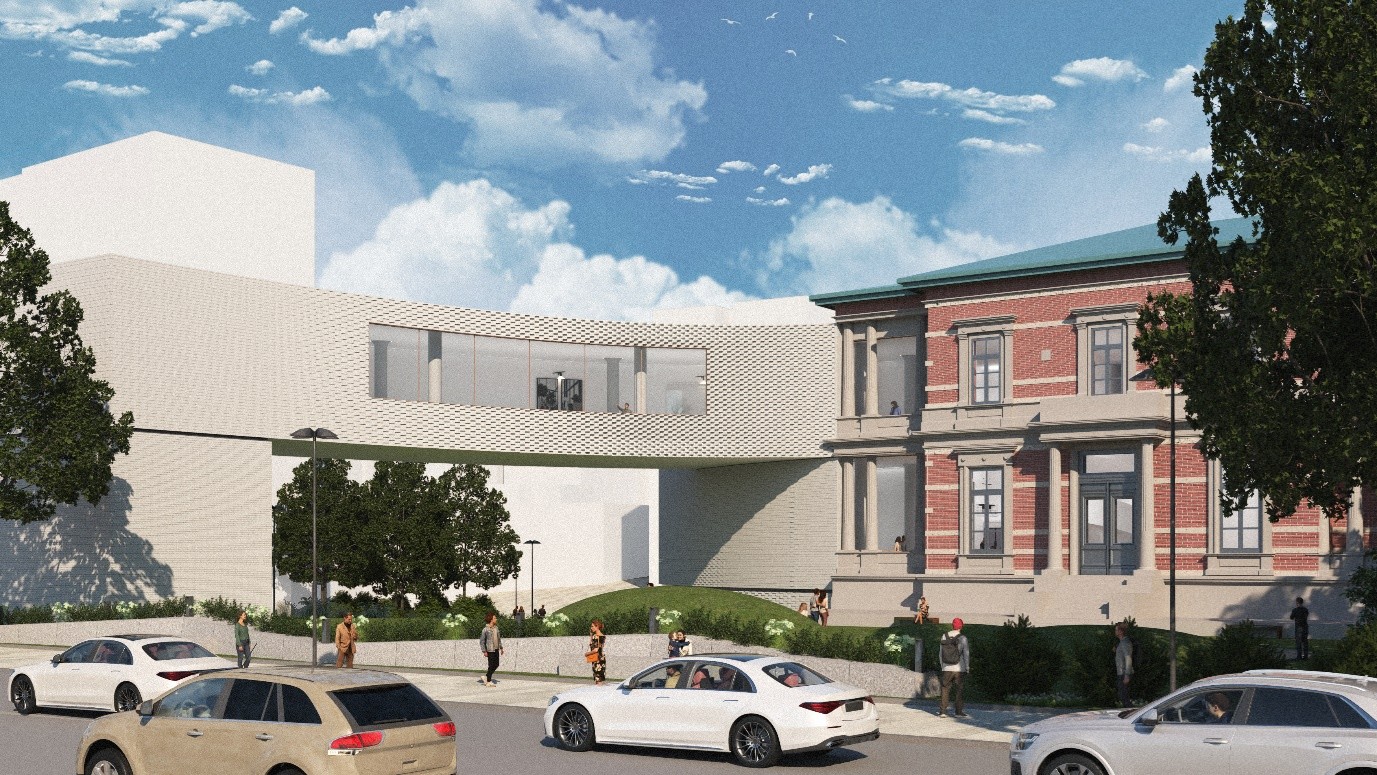
미술관으로 향하는 그리고 도시와 연결되는 새로운 흐름을 만들기 위해서 시각적인 개방이 필요하다고 판단했다. 이에 은행을 드러내고 기존 건축물에 대한 최소한의 개입과 함께 순환되는 흐름을 위한 매스를 증축한다. 이에 따라 만들어지는 동선과 함께 기존 건축물 내부에도 전 층을 관통하는 원형의 순환 동선을 만든다. 그 결과 과거와 현재의 흐름이 함께 공존하고 어우러지는 공간으로 거듭난다.
To create a new flow leading toward the museum and connecting it to the city, visual openness is essential. With this in mind, the bank is revealed, and an additional mass is introduced to support a continuous circulation flow, while keeping interventions to the existing building to a minimum. Inside the original structure, a circular circulation path is added, penetrating all floors from top to bottom. As a result, the space is transformed into one where the flows of past and present coexist and intertwine harmoniously.
Program

Structure

새로운 매스를 구성함에 있어서 최소한의 기둥으로 공간을 계획하고 창을 통해 보이는 미술관의 앞마당 시선을 확보하기 위해 Virendeel-Truss 구조를 활용하였다. 추가적인 경사재 없이 강접합하기 위한 형태를 추가함으로써 직선형의 긴 구조에서 보이는 새로운 흐름은 더욱 명확해질 수 있다.
In designing the new mass, the space was planned with a minimal number of columns, and a Vierendeel truss system was employed to secure views of the museum’s front courtyard through the windows. By incorporating a form that allows for rigid connections without additional diagonal members, the new flow expressed within the elongated, linear structure becomes even more pronounced.
Drawing


AXONOMETRIC

Detail Section


Section

Images


Maquette


credit
혹시 콘타는 어떤 프로그램으로 만드시나요?? 제가 만드는 것보다 등고가 자세한 것 같아 여쭤봅니다! 프로젝트 너무 멋있어요 !!! 잘보고 갑니다